
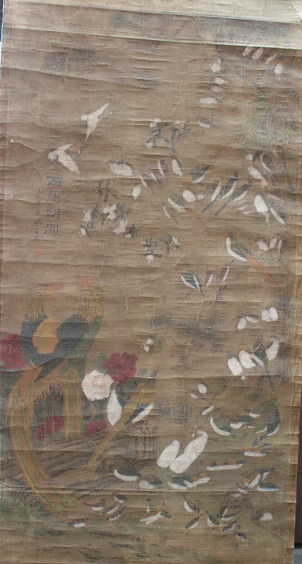
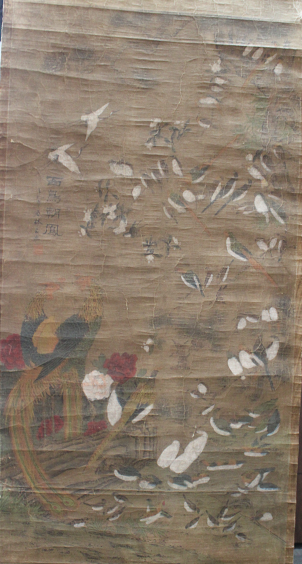
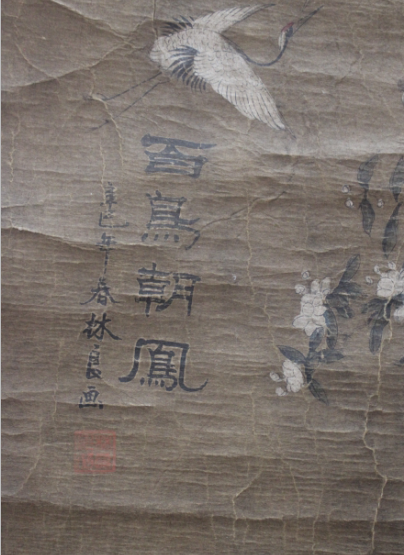
藏品名称:林良 百鸟朝凤
规格:长:115cm 宽:60cm
类别: 书画
收藏家:张先生
林良(约公元1428-1494),字以善,广东南海扶南堡(今广东佛山市南海区大沥)人,明代著名画家,广东绘画史上第一个进入主流性行列的画家。
史料记载“林良吕纪,天下无比”,他因善画而被荐入宫廷,授工部营缮所丞,后任锦衣卫指挥、镇抚,值仁智殿。绘画取材多为雄健壮阔或天趣盎然的自然物象,笔法简练而准确,写意而形具。
林良是明代院体花鸟画的代表人物,也是明代水墨写意画派的开创者,在明代院体画中独树一帜,对后世画坛,包括宫廷画家、职业画家、文人画家均产生重大的影响。
Lin liang (about 1428-1494), styled yishan, was born in funanbao (now Dali, nanhai district, foshan city, guangdong province), a famous painter in the Ming dynasty.
According to historical records, "Lin liang and lu ji were incomparable in the world". He was recommended to the court for his good painting skills, and was awarded the post of secretary of the ministry of works and calligraphist. Later, he served as the commander of jinyi wei and the governor of zhenfu, and was awarded the hall of renzhi. Most of the materials used in painting are vigorous and magnificent or natural objects full of interest.
Lin liang is the representative figure of the style of flower and bird painting in the Ming dynasty, and also the founder of the style of Chinese ink painting in the Ming dynasty. He developed his own school in the style of courtyard painting in the Ming dynasty, which had a great influence on the painting circles of later generations, including court painters, professional painters and literati painters.
林良(1428年~1494年)字以善,明代著名画家,广东南海扶南堡(今佛山市南海区大沥)人 [1] 。擅画花果、翎毛,着色简淡,备见精巧。其水墨禽鸟、树石,继承南宋院体画派放纵简括笔法,遒劲飞动,有类草书,墨色灵活,为明代院体花鸟画的代表作家,也是明代水墨写意画派的开创者。传世作品有《灌木集禽图》、《山茶白羽图》、《双鹰图》等。
林良(1428年~1494年)字以善,明代著名画家,广东南海扶南堡(今佛山市南海区大沥)人 [1] 。擅画花果、翎毛,着色简淡,备见精巧。其水墨禽鸟、树石,继承南宋院体画派放纵简括笔法,遒劲飞动,有类草书,墨色灵活,为明代院体花鸟画的代表作家,也是明代水墨写意画派的开创者。传世作品有《灌木集禽图》、《山茶白羽图》、《双鹰图》等。
林良早期所作设色花果翎毛,画法工细精巧,后来师承南宋放纵简括一路,变为水墨粗笔写意,取得突出成就。在表现技法上,挺健豪爽的笔法,既有迅捷飞动之势,又比较沉重稳练;在运笔顿挫之间,讲求规矩法度。后人评论他的画风是用笔遒劲,如作草书。他的水墨写意花鸟画,在当时上追南宋院体,竞尚艳丽工巧的宫廷画风中独树一帜,故颇为当时人所推重,对明代中期的花鸟画风产生很大影响。
Lin liang (1428 ~ 1494), a famous painter in Ming dynasty, was a native of funanbao (now Dali, nanhai district, foshan city) in nanhai, guangdong province [1]. Be good at drawing flower, flower, feather, coloring is brief light, have see choiceness. Its ink birds, trees and stones, inherited the southern song dynasty courtyard style painting school indulge in simple brushwork, dashes vigorously, cursive, flexible ink, for the Ming dynasty courtyard flower and bird painting representative writers, but also the Ming dynasty ink painting school of freehand brushwork. His works have been handed down from generation to generation, such as "birds in the bush", "white feather in camellia", "double eagle" and so on.
Lin liang (1428 ~ 1494), a famous painter in Ming dynasty, was a native of funanbao (now Dali, nanhai district, foshan city) in nanhai, guangdong province [1]. Be good at drawing flower, flower, feather, coloring is brief light, have see choiceness. Its ink birds, trees and stones, inherited the southern song dynasty courtyard style painting school indulge in simple brushwork, dashes vigorously, cursive, flexible ink, for the Ming dynasty courtyard flower and bird painting representative writers, but also the Ming dynasty ink painting school of freehand brushwork. His works have been handed down from generation to generation, such as "birds in the bush", "white feather in camellia", "double eagle" and so on.
Lin liang early formed-color flowers, flowers and feathers, fine and delicate painting, then under the southern song dynasty indulged in a simple road, into the ink brushwork freehand, made outstanding achievements. In the performance technique, quite strong and forthright style of writing, both fast and fast, and more heavy and steady; In between the strokes, rules and regulations. His style of painting has been commented by later generations. His painting style of flowers and birds with freehand brushwork of water and ink was catching up with that of the southern song dynasty, which was unique among the gorgeous and skillful court painting style. Therefore, it was highly valued by people at that time, and had a great influence on the painting style of flowers and birds in the middle of Ming dynasty.
林良,约生于1428年(宣德三年),字以善,南海(今属广东省)人,卒于1494年(弘治七年)前,享年六十余岁。且按照1464年(天顺八年)前林良入宫计算,其时林良三十余岁,画艺已经成熟。“始,主事颜宗善山水,知府何寅善人物,皆乡先生也。良每学之,独畏宗,曰:颜老天趣为不可及也。晚复为白描小景,然终不及翎毛花草之工。后拜工部营缮所丞。夤缘巨挡,得直仁智殿,改锦衣卫镇抚。良善谑咏,已而沾士大夫膏馥,为诗始颇有可观者。都御使何经号敏捷,日与之剧饮唱和,或顷刻成诗百篇,因结为兄弟,良由是名益显云。”这两位可以说是林良较早的师承,“虽然后来他以花鸟著称,山水和人物均无闻,但无疑在造型和笔墨上有所得益,从而奠定了较扎实的根基”。
在永乐至成化年间(1403-1487),以绘事供奉内廷者多直仁智殿。林良直仁智殿时地位也不高,与百工杂流为伍,尚属画工之列。后改锦衣卫镇抚,才算有了从六品的较高官职。所授为武职,有品级之分,官阶一般比文官高。由于锦衣卫恩荫寄禄无常员,没有固定的员额限制,故很多受皇帝恩宠的宫廷画家得授锦衣卫武职。但他们仅领奉薪,不事其职,亦无实权。“林良任锦衣卫镇抚后级别有所提高,能经常应诏作画而接近皇帝,并有机会观赏到不少内府藏画,还结识了其他宫廷画家和一些朝廷王公大臣,这些都对他的画艺提高和声名播扬起了重要作用。”
Lin liang, born about 1428 (the third year of xuande), styled yishan, and born in nanhai (now part of guangdong province), died in 1494 (seven years before the reign of emperor hongzhi) at the age of over 60. And according to 1464 (eight years of tianshun) before Lin liang into the palace calculation, when Lin liang more than 30 years old, painting has been mature. "Beginning, the chief yan zongshan mountains and rivers, the magistrate he yinshan figures, all Mr. Township. Liang every learning, wei zong alone, said: yan old tianqu for unreachable. Late for the deion of small scene, but not to the work of the feather flowers. Later, the ministry of public works was appointed by cheng. That is pleasing, straight renzhi palace, to bright wei zhen fu. Good xueyong, already with the scholastic fu, for the poem began quite a viewer. All the imperial ambassadors were swift in their Numbers, singing with them in their plays, or instantly composing hundreds of poems. These two can be said to be Lin liang's early teacher, "although later he is known for flowers and birds, landscape and figures are not heard, but undoubtedly in the shape and ink on the benefits, thus laying a solid foundation.
During the period from yongle to chenghua (1403-1487), many upright renzhi halls dedicated to the neiting were inscribed with carvings. Lin liangzhi renzhi temple when the status is not high, and the miscellaneous flow of hundred workers, is still one of the painting. After the town to jin yi wei fu, only then has a higher official position from six products. For the military, there are grade points, rank is generally higher than civil servants. Due to the inconstancy of the jinyi wein senlu, there was no fixed post limit, so many court painters who were favored by the emperor were granted the jinyi weilu military post. But they are paid, not employed, and have no real power. "Lin liang was promoted to a higher level after he was appointed governor of jinyi wei. He was able to draw regularly in accordance with a decree and was close to the emperor. He also had the opportunity to see and admire many paintings in the inner palace.
自宣德年以后,由于宫廷美术的“文人画化”,林良后期不乏“以气韵为主,以写意为法,以笔情墨趣为高逸,以简逸悠淡为神妙”的作品。林良醉心于水墨花竹、水边沙外凫鸭鹭雁等江湖荒野之景,以标榜其风雅。他驻足于各类雄健壮阔、天趣盎然的水陆禽鸟、苍松及古树等山野江湖景色。每幅作品简练而富有深意:1.不乏“心意”。当你驻足思索,会发现整幅画所表现的不再只是双雁,似乎双雁是现实中真人的写照,突出了这个人的“饥”和“寒”。由此挥发出林良由“物意”转为“心意”的凸显,重“心意”而薄“物意”。2.“意境”的释放。林良不去画宫廷苑囿中华贵锦绣的珍禽异鸟、名花奇石去迎合帝王,而去画寒冬中双宿双栖的孤雁?那些生活在上层阶级的达官贵人在饮酒当歌的同时,有多少劳苦大众在呻吟中挣扎?林良身为御用画师衣食无忧,但作为一个爱国的子民,他在采风中对所碰到的这每一个场景都历历在目,感触尤深。但是他充其量是一个帝王娱乐的工具,即便他再怎么关心民间疾苦,也只是敢怒不敢言。然而,他手中之笔却道出了心中所思,也使林良获得了较以往宫廷苑囿中截然不同的鲜有的素材。因此在林良整幅画里看到的不仅是审美主体对外在审美物象的描绘,而更多的是他自己内在心灵的抒发。林良对于美的追求不再囿于客观物象本身的形似、神似,而是在其客观美的创作中融入了其主体本人的所思所想,他笔下的美更多的是本人对自身思考的流露与外化。这应该就是“意境”的释放。3.“笔意”的转变。林良后期“文人画化”的作品里,不再以单纯简劲的线条、艳丽华贵的设色意象来表现,而是转向于笔墨的浓淡干湿变化。
林良更发展了笔和墨的技巧,独具艺术特色,创造出“文人画化”的水墨写意花鸟画风格,其水墨写意花鸟画成为花鸟画坛的主流。
Since xuande year, due to the "literati painting" of court art, Lin liang's later period has not been short of works that "give priority to the artistic charm, take freehand brushwork as the method, take the feeling and interest of ink brush as the high and elegant, take the simplicity and ease as the magic". Lin liang is fascinated by the wild scenery of rivers and lakes such as bamboo with ink flowers, duck, heron and wild goose outside the sand by the water's edge, so as to flaunt its elegance. He stands in a variety of magnificent, interesting, water and land birds, pines and ancient trees and other landscapes. Each piece of work is concise and full of profound meaning: 1. When you stop to think, you will find that the whole picture is no longer just two wild geese. It seems that the two wild geese are the portrayal of real people in reality, highlighting the "hunger" and "cold" of this person. From this volatilize Lin liang by "content meaning" turn to "intention" highlight, heavy "intention" and thin "content meaning". 2. Release of "artistic conception". Lin liang do not go to the palace park in the picture of the magnificent rich and beautiful rare birds, flowers and stones to meet the emperor, and go to the picture of winter in the twin-habitat wild goose? Those who live in the upper class dignitaries in drinking when the song, how many laboring masses in the moaning struggle? Lin liang as the emperor painter food and clothing, but as a patriotic people, he encountered in the wind in each of these scenes are vividly in the eye, feeling particularly deep. But he was at best a tool of imperial amusement, and no matter how much he cared about the sufferings of the people, he dared not speak out. However, the pen in his hand says what he thinks in his heart, and makes Lin liang get very different materials than before in the court garden. Therefore, what Lin liang sees in his whole painting is not only the deion of aesthetic objects, but also the expression of his inner soul. Lin liang's pursuit of beauty is no longer limited to the likeness in shape and spirit of the objective object itself, but integrates the subject's own thoughts in his creation of objective beauty. The beauty in his works is more about the revelation and externalization of his own thinking. This should be the release of "artistic conception". 3. Transformation of the "meaning of writing". In his later works of "literati painting", Lin liang no longer used simple and strong lines and gorgeous and luxurious color imago to express, but turned to the changes in the shade, dryness and wetness of his brush and ink.
Lin liang also developed the skills of pen and ink, and created a "literati painting" style of freehand brushwork in flower-and-bird painting, which became the mainstream of flower-and-bird painting.
林良多取材为雄健壮阔或天趣盎然的自然物象,如苍鹰、芦雁、鹤鹭、孔雀、锦鸡、寒鸦、麻雀、喜鹊等禽鸟,以及苍松古树、芦荻、灌丛等野生草木;以遒劲纵逸、气势雄阔的笔墨,来表现富勇猛、野逸之趣的生物,两者结合恰当完美,生动传神。每幅必以两大鸟为主,树梢空中点以小禽,皆粗笔仗大点大抹而成,如金鸡之腹,以巨笔蘸朱砂自膝下至尾,一直扫下,而圆厚胜细匀者万万,尤妙绝者,一幅作暮景晚烟横树,而以淡墨写栖鸦,只一笔点成,不加嘴爪,不分翎毛,为烟中宿者,入神之笔也。然而他的水墨写意画,亦非逸笔草草,不求形似所绘扬逸造型仍很准确,类属品种一一可辩,在一抹阔笔中,也时时补以较细勾勒,以呈现轮廓。
这件书画是深圳亿鑫国际拍卖有限公司经过多方努力征集而来,会于2019美国洛克菲勒春季拍卖会展现。具有更高的考古价值、艺术价值、欣赏价值、收藏价值等。欢迎海内外朋友一起目睹其风采。
Most of Lin liang's materials are vigorous and magnificent natural objects, such as goshawk, reed goose, heron, peacock, golden pheasant, jackdaw, sparrow and magpie, and wild vegetation such as pines, reeds and shrubs. With vigorous and elegant, magnificent ink, to show the bold, wild and interesting creatures, the combination of the two is perfect, vivid. Each will give priority to with two big birds, the trees air point in small birds, are coarse wipe pen battle big points, such as abdominal jinji, giant pen to dip in vermilion from knee to end, has been sweeping the, thick, round never - well, especially wonderful unique, cross a picture for an evening scene late smoke tree, and the light ink to write a habitat crow, only a point, not mouth, regardless of their feathers, the smoke in the lodge, into god pen also. However, his freehand brushwork in ink painting is not the same as that in yi brush painting. It does not ask for the same shape as that in yi brush painting, and the style of Yang yi is still very accurate.
This painting and calligraphy was collected by shenzhen yixin international auction co., LTD after efforts from various parties, and will be displayed at the spring auction of Rockefeller in 2019. It has higher archaeological value, artistic value, appreciation value, collection value and so on. Welcome friends at home and abroad to witness its elegant demeanor together.